Data Integration process
Use the Data Integration process to retrieve and manipulate data from your ERP system. The process requires you to specify resources (Site and Job) that a Global Administrator sets up beforehand in Data Integration.
This process has the following parameters:
- Description: Optional. Up to 250 characters.
- Site: Select the site that you want to use.
- Job: Select the job definition that you want to use.
How long the process runs
The Data Integration process does not have a time limit; it will run as long it needs to complete. However, it monitors the data integration agent running on the ERP server and if the agent stops running, the Data Integration process ends. The process is then marked as failed and will not restart. You can also cancel the process in the Task Log.
Override DI filter values
Data Integration (DI) jobs use query filters to control which data is extracted — for example, a fiscal period, company code, or date range. You can override these filter values directly in Process Manager, without leaving FP&A Plus or involving a DI administrator.
If a DI administrator marks filters as Exposed on a task in DI, those filters become available for override in Process Manager.
After you select a Site and Job in a Data Integration process step, Process Manager automatically displays any tasks that have exposed filters, along with their filter names and current default values. You can accept the defaults or enter replacement values that will apply when the process runs.
Note: Only tasks with exposed filters are shown. Tasks without exposed filters continue to run using their existing values.
Add a Data Integration process with filter overrides
-
Select an existing Process Group or create a new one.
-
Add a new process step and set the type to Data Integration.
-
Select the Site that contains the job you want to run.
-
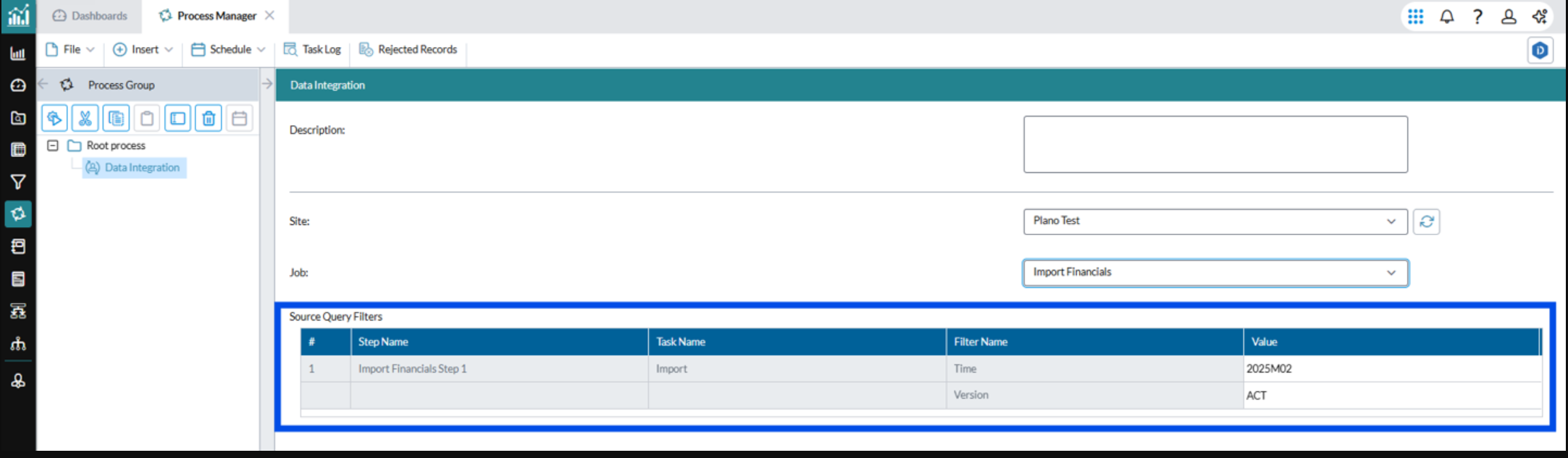
Select the Job. Process Manager checks whether any tasks in the selected job have exposed filters. If they do, Source Query Filters section appears, listing each task and its exposed filters.
-
For each filter you want to override, type the new value in the Value field next to the filter name.
For any filter you want to keep at its default, leave the value unchanged.
-
Click Save.
Tip: Hover over a Value field to see a sample format — for example, YYYY-MM-DD for a date or USD for a currency code.
Edit existing filter overrides
-
Open the Process Group that contains the Data Integration step.
-
Click the Data Integration process step to open it.
-
Update the filter values as needed.
-
Click Save.
How filter values are applied at runtime
When the process runs, filter values are applied in the following order (highest priority first):
-
Process Manager override – value entered in Process Manager.
-
Task default – value defined in the DI task.
-
Query default – value defined in DI Admin Setup.
If you remove an override value (leave it blank), the system uses the task default, or the query default if no task default is set.
Troubleshooting
No filter parameters appear after I select the job.
The tasks in that job have no exposed filters. Ask your DI administrator to open DI, navigate to the relevant task in Job Definitions, and select the Exposed option in the filters you need to override.
The process ran but used the wrong filter value.
Verify that the value in Process Manager matches the expected format shown in the tooltip. A format mismatch, for example, entering March 2026 instead of 2026-03, may cause the system to ignore the override and fall back to the default value in DI.
A filter is listed but I cannot edit its value.
The filter may be read-only at the Process Manager level. Confirm with your DI administrator that the filter is both exposed and editable in DI.
The Data Integration process step fails when it runs.
Check that all required filter values have been entered. If a filter has no override in Process Manager and no default set in DI, the job may fail due to a missing required parameter. Enter a value in Process Manager, or ask your DI administrator to set a default on the task in DI.
FAQ
Can I override some filters and leave others unchanged?
Yes. Enter values only for the filters you want to override. Any filters you leave unchanged will use their default values from DI.
Does changing a filter value here affect the job in DI?
No. Overrides in Process Manager apply only to the specific process step. The original job and task definitions in DI are not affected.
Can different process groups use the same DI job with different filter values?
Yes. Each Data Integration process step stores its own override values. This allows you to reuse a single job for multiple purposes, such as running reports for different time periods.
What user role is required?
You must have the Advanced user role or higher in FP&A Plus, with access to Process Manager.
Will I be able to use dimension members as filter values?
Not yet. This release (2026.4.3) supports manually entered (hardcoded) values only. Future updates are expected to support selecting dimension members and choosing whether to use keys or names.